

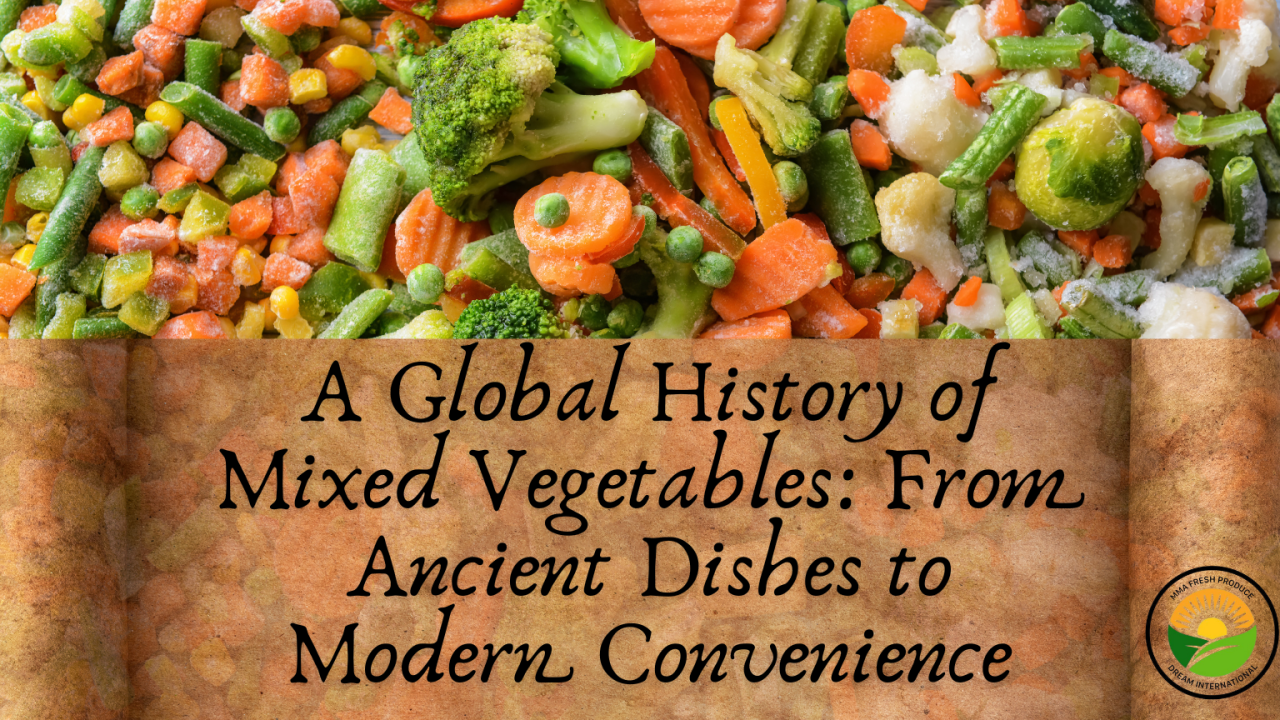
A Global History of Mixed Vegetables: From Ancient Dishes to Modern Convenience
Mixing an assortment of vegetables in one dish is a culinary idea as old as civilization itself. Across continents and eras, people found that combining different greens, roots, and legumes not only created flavorful harmony but also provided nutritional balance. From ancient Roman salads and Javanese peanut sauces to European vegetable stews and today’s frozen medleys, mixed-vegetable dishes have been a staple of human diets – evolving with culture, trade, and technology.
Ancient and Traditional Origins of Vegetable Medleys
One of the earliest documented mixed-vegetable dishes comes from Java, Indonesia. Pecel is a classic Javanese salad of lightly blanched greens (like cassava or papaya leaves, water spinach, long beans, bean sprouts, etc.) tossed in a spicy peanut sauce. In fact, pecel is recorded in 9th-century inscriptions from the Mataram Kingdom, indicating that Javanese people were enjoying mixed vegetables with peanut (a legume) sauce over a millennium ago. The peanut-based dressing not only adds flavor but also protein – an early example of using legumes to enrich vegetable dishes. A closely related Indonesian salad is gado-gado, essentially a more elaborate cousin of pecel. Gado-gado (which literally means “mix-mix”) includes boiled vegetables along with additions like tofu, tempeh, hard-boiled eggs, and lontong (rice cake), all blanketed in peanut sauce. Gado-gado emerged during the Dutch colonial period (early 20th century) and became popular enough to be featured in colonial cookbooks and, later, in restaurants worldwide as “Indonesian salad.”

Elsewhere in Asia, China’s culinary tradition was incorporating mixed veggies from early times as well. Stir-frying – which became common by the post-Han Dynasty period – was a technique well-suited to cooking an assortment of bite-sized ingredients together . Ancient Chinese stir-fry dishes often blended items like bamboo shoots, mushrooms, greens, and sometimes tofu or pork, creating a balance of colors, textures, and flavors in one. This idea of a harmonious medley is exemplified by dishes such as Buddha’s Delight (an all-vegetable stir-fry from Chinese Buddhist cuisine) and many regional stir-fries. In the Indian subcontinent, meanwhile, there arose countless sabzi (or subzi) dishes – essentially mixed vegetable preparations, either dry sautéed or curried with spices. Every region had its own twist: for example, avial in Kerala is a renowned mixed-vegetable curry with a coconut-yogurt base (legend credits its invention to Bhima from the Mahabharata, highlighting its mythic antiquity), and undhiyu in Gujarat is a hearty mix of seasonal winter vegetables and chickpea flour dumplings slow-cooked upside-down in an earthen. These dishes, dating back many centuries in local oral history, show how Indians expertly combined what was available – tubers, gourds, beans, leafy greens – along with aromatics and spices to create wholesome composites.
Egyptian Zucchini

Persian and Central Asian cuisines also cherished mixed greens and vegetables. Persians have long enjoyed sabzi khordan, an herbed salad platter where fresh herbs (mint, basil, tarragon, cilantro, etc.) are eaten together with vegetables, cheese and bread – a practice noted since medieval times. They also developed robust stews like ghormeh sabzi which unites multiple greens with beans and meat. Such dishes underscore the principle that a variety of plants eaten together yields a more complete flavor and diet. In the Korean peninsula, the tradition of mixing vegetables took a unique form. A typical Korean meal includes numerous namul – side dishes of seasoned vegetables such as spinach, bean sprouts, fernbrake, radish, and more – each prepared separately with garlic, sesame, soy sauce, or chili. Eventually, this idea led to bibimbap, literally “mixed rice,” where a bowl of rice is topped with an assortment of sautéed or blanched veggies, plus often an egg and meat, then thoroughly mixed together with chili paste. What began as a convenient way for farmers to toss leftovers together became an iconic dish; early records of bibimbap (under older names like goldongban) appear in Korean documents by the 16th–19th. The very concept of bibimbap – mixing various namul and rice in one vessel – exemplifies the universal appeal of combining foods for ease and taste. In Japan during the Edo era (1600s–1800s), simple mixed-vegetable side dishes gained popularity, emphasizing visual balance and natural flavor. Kinpira is a Japanese method of braising sliced root vegetables; the classic kinpira gobo stir-fries burdock root with carrots in a sweet-soy glaze until both ingredients harmonize. Likewise, ohitashi (blanched greens like spinach in a light dashi-soy broth) offers a mélange of leaves infused with subtle seasoning. These Japanese dishes, though modest, highlight a philosophy of combining a few complementary vegetables to achieve nutritional and aesthetic balance on the plate.
Egyptian Carrot Slices

European Vegetable Blends in History
Europe has its own long history of mixed-vegetable concoctions. The very word salad comes from Latin herba salata, meaning “salted greens,” harking back to the ancient Greeks and Romans who ate assorted greens dressed with oil, vinegar, and salt (often with a dash of fermented fish sauce for umami). A platter of mixed lettuce, endive, celery, and herbs in a tangy dressing would not have been out of place on a Roman table – a direct ancestor of today’s salads. In the daily diet of medieval Europe, a humbler mixture prevailed: pottage. This was a thick soup or porridge into which people tossed whatever grains, beans, and vegetables were available – peas, cabbage, onions, carrots, turnips, nettles – simmering them together sometimes for days. Pottage was the staple of peasants across Northern Europe, a frugal one-pot meal that essentially combined everything to. Though lacking refinement, pottage kept generations nourished and can be seen as the precursor of many European vegetable soups and stews.

By the 17th and 18th centuries, more elaborate and artful vegetable mixes appeared, especially in aristocratic and bourgeois cuisine. One famous example from England is Salmagundi (sometimes spelled salmagundy). Far from a simple salad, salmagundi was a lavish presentation of a bit of everything: an array of cooked and raw vegetables, chopped meats, seafood, fruits, nuts, hard-boiled eggs, and edible flowers, all arranged in an ornate platter and drizzled with . The concept first pops up in English records in the 1600s, the term deriving from French salmigondis meaning a hodgepodge or disparate. Indeed, salmagundi was exactly that – a miscellaneous mixture intended to impress diners with its variety and abundance on the table. It became a highlight of banquets in the Stuart and Georgian eras, embodying the idea that more is more when it came to ingredients. This eye-catching dish is often considered a forerunner of composed salads and even modern chef’s salads, where distinct ingredients are arranged together rather than tossed.
Leipziger Allerlei, a traditional German mixed-vegetable dish (with peas, carrots, morels, asparagus and a Hollandaise sauce), originated in the 18th–19th century as a celebration of seasonal produce.

On the continent, German-speaking regions were also combining veggies in creative ways. The most iconic is Leipziger Allerlei – literally “Leipzig all-sorts.” As the name suggests, it’s a medley of various vegetables, typically young spring produce: peas, carrots, green beans, white asparagus tips, cauliflower, morel mushrooms, etc., often sautéed in butter or served in a creamy sauce with accompaniments like potato dumplings. A local legend claims the dish was invented in Leipzig after the Napoleonic Wars as a bit of gastronomic deception: by serving only vegetables, the city hoped to appear too poor to interest beggars or tax. (Wealthier ingredients like crayfish or ham were hidden in the mix on special occasions.) Whether or not that tale is true, recipes for Leipziger Allerlei were recorded in German cookbooks by the mid-18th. It essentially codified the practice of the “vegetable platter” – a selection of whatever produce was in season – into a beloved regional specialty. So popular was the concept that in modern times Leipziger Allerlei became commodified: canned or frozen mixtures of peas, carrots, and asparagus bits are sold under that name, albeit bearing little resemblance to the fresh . Similarly, France in the 1700s developed the style of serving vegetables “à la jardinière,” meaning “gardener’s style.” A classic jardinière mix would include diced or turned young vegetables – carrots, turnips, pearl onions, green beans, peas – gently cooked in butter or stock, sometimes with herbs, to accompany a roast. This French approach treated mixed vegetables as a refined side dish in its own right, emphasizing their freshness and sweetness (often even glazing them with sugar and butter). The idea was to bring the entire garden’s bounty to the table in one dish, much like the German Allerlei, but with French finesse.
Egyptian Broccoli Florets

By the 19th century, the concept of mixed vegetables even entered the realm of cold appetizers and snacks. The Russian Salad – also known as Olivier salad – exemplifies this. It was invented in the 1860s by Lucien Olivier, a Belgian-French chef in Moscow, and originally was a very grand affair: a composition of diced grouse, smoked duck, veal tongue, crayfish tails, potatoes, cornichons, truffles, caviar, hard-boiled eggs, and more, bound with a secret Provencal-style dressing (mayonnaise-like). Chef Olivier’s creation became hugely popular; even as the exact recipe was kept secret, imitations sprang up. Over time – especially during the Soviet era – this salad’s recipe was simplified and democratized, substituting cheaper ingredients and mass-produced mayo. The modern salat Oliv’ye commonly contains boiled potato and carrot cubes, peas, pickles, eggs, and a mild bologna-style sausage or ham, all held together by. It’s a staple at celebrations in Russia, Iran, and many European countries (often just called “Russian potato salad”). While not a pure vegetable dish due to the meat and rich dressing, Olivier salad’s enduring global fame showed how a mixed-vegetable salad could capture people’s hearts and palates. It took the idea of salmagundi (a bit of everything) and packaged it into a convenient, scoopable form – something that could be spread on bread or served as an hors d’oeuvre.
Across the Atlantic, the Americas also had their native mixed-vegetable traditions. Indigenous peoples in North America cultivated the “Three Sisters” – corn, beans, and squash – which grow well together and complement each other nutritionally. A dish combining all three is succotash, originally a Narragansett word (sohquttahhash meaning “broken corn kernels”) for a stew of corn and beans to which squash or other vegetables might be. Early records note that Northeast tribes were making succotash by the 17th century, sometimes cooking the corn and beans with bear fat or meat for. Colonists, encountering this hearty mix, adopted it; succotash became a part of early American cookery and remains a classic New England side dish (often featuring lima beans and corn). The brilliance of succotash is that by combining a grain (corn) with legumes (beans), the dish provides a complete protein profile – a fact now understood scientifically, but arrived at through indigenous agricultural. Further south, in Latin America, Spanish colonizers mixed Old World and New World ingredients to create sustaining stews that persist today. Sancocho is a perfect example: in places like the Caribbean, Colombia, Venezuela, and the Dominican Republic, sancocho evolved as a thick soup blending European-introduced meats (pork, beef, or chicken) with native tropical vegetables and tubers – plantains, yuca (cassava), malanga, squash, corn cobs, etc. The result is a rich mosaic in a pot. The dish likely descends from Spanish cocido (itself a mix of meats, chickpeas and veggies), with influences from African cooking. Every country’s sancocho is a bit different, but all illustrate the central idea: throw a variety of ingredients into one cauldron and slow-cook it to perfection. Similar mixed soups/stews include ajiaco in Colombia, locro in the Andes, and gumbo in Louisiana – all born from cultural convergence and the need for one dish that feeds many. They demonstrate that mixed vegetable dishes need not be salads; they can be comforting broths and hearty stews that are meals in themselves.
From Farm to Factory: Mixed Veggies in the Modern Era
While traditional mixed-vegetable dishes were tied to seasonal harvests and regional tastes, the 20th century unleashed industrial technologies that would globalize and standardize how we consume our veggies. A key breakthrough came with frozen food. In 1924, Clarence Birdseye, an American inventor, perfected a quick-freezing method that could preserve the taste and texture of foods much better than previous slow-freezing. By packaging produce and freezing it rapidly to subzero temperatures, Birdseye found that even delicate items like peas retained their sweetness. This innovation gave birth to the frozen food industry and, before long, companies were selling bags of frozen mixed vegetables – often a blend of peas, diced carrots, green beans, and corn – as an easy pantry (or rather, freezer) staple. For the first time in history, a cook didn’t need a garden or a trip to the market to have a medley of vegetables at hand; one could simply open a freezer and pour out a pre-cut mix that was ready to boil or microwave. By eliminating seasonal constraints (freezing peas in spring, corn in summer, etc., and mixing them together), these products made the “vegetable medley” a year-round convenience. The idea of mixing vegetables thus moved from the context of regional recipes to a mass-produced commodity in supermarkets worldwide.
Another 20th-century development was the rise of packaged salads and canned goods. Food processors began canning mixed veg as early as the 19th century (for example, assortments used in Russian salad, or soup mixes), but the mid-20th century saw an explosion of ready-to-use vegetable combos. Mixed pickles (like chow-chow or giardiniera) offered tangy assortments in jars, and companies marketed things like “vegetable hash” or minestrone mix in cans. In the late 20th and early 21st century, pre-washed, bagged salad mixes became incredibly popular. Instead of washing and chopping heads of lettuce and assorted veggies, consumers could buy a sealed bag containing a mix of lettuces, carrots, cabbage shreds, etc., ready to toss with dressing. These salad kits epitomize convenience and have shifted how people eat raw vegetables. In the 2010s, sales of bagged greens and salad kits in the U.S. climbed dramatically (expected to reach around $7 billion annually), reflecting that many households now prefer the ease of pre-mixed salads over assembling ingredients. What began as a simple idea – put different vegetables together in a dish – has thus come full circle in modern life: we still crave variety in our vegetables, but now technology and industry do a lot of the mixing for us.
A Tradition That Lives On
Surveying the world of mixed-vegetable dishes reveals a remarkable common thread: whether developed for practicality, nutrition, or festivity, these dishes celebrate diversity on the plate. They arose independently in different cultures – a steaming pot of medieval pottage was a far cry from a chilled salmagundi platter, yet both answered the universal need to make the most of available ingredients. Today, we enjoy an astonishing array of mixed vegetable creations. You might start your day with an omelette aux fine herbes (eggs folded with a mix of herbs and greens), have ratatouille (the French Provençal stew of eggplant, zucchini, peppers and tomatoes) for lunch, snack on pakoras (Indian vegetable fritters mixing spinach, onion, potato in a spiced batter), or dine on a classic stir-fry or curry. And of course, there’s the ubiquitous bowl of salad or the side of peas-and-carrots. Every time we relish these, we’re participating in a longstanding human habit of culinary collage – combining different plant foods to create something tastier, healthier, and more interesting than each component alone.
From the ancient fields of Java and Rome to our modern kitchens, mixed vegetables have proven to be more than the sum of their parts. They reflect agricultural history (the spread of crops like peanuts, potatoes, and chilies enabled new combinations), cultural exchange (as seen in hybrid dishes like sancocho or chop suey), and even technological change (frozen veggies and packaged salads altering how we cook). Yet at heart, the appeal of mixed vegetables remains simple and enduring: a variety of colors, textures, and flavors in one dish, providing comfort and nourishment. It’s a tradition that continues to adapt – who knows what new mixed-veggie innovations the future might bring? – but one that surely will never go out of style, as long as we enjoy eating our vegetables. Bon appétit to that!
Best Regards