

The Global Trade in Frozen Potatoes (French Fries) and Egypt’s Rising Role – 2025 Edition
Introduction
Frozen prepared/preserved potatoes – mostly French fries – have grown from a small niche segment to a US$13.6 billion industry in 2024. Rising demand comes from quick‑service restaurants, ready‑to‑eat meals, and home‑cooking trends like air‑frying. Despite temporary supply shocks, global exports and imports of frozen potatoes continue to expand, fuelled by investment in processing capacity and shifting trade flows.
This report synthesizes recent market news and statistics (up to late 2025) to outline the main players in the frozen potato (French fries) trade. It highlights the largest fresh‑potato producers, leading frozen‑fries manufacturers, top exporters, importers, and consumers by country. Egypt’s emerging role as both a major fresh producer and fast‑growing supplier of frozen fries is a focal point.
Top Fresh‑Potato Producers
Potato production has been stable globally (~383 million tons in 2023). The top producers overwhelmingly belong to Asia, reflecting the crop’s importance in both food security and industry. According to FAO data compiled by Potatopro:
Top Fresh Potatoes Producers

Egypt’s 2023 harvest (≈6.9 million tons) places it within the top ten, underscoring strong agronomic potential and export capacity. Egyptian potatoes are available from January to June, with cold‑storage extending supply into Octoberpotatopro.com.
Consumption patterns
Per‑capita potato consumption is highest in Eastern Europe. World Population Review data for 2022 lists Belarus (160 kg), Ukraine (139 kg), Kazakhstan (105 kg), Kyrgyzstan (103 kg) and Uzbekistan (97 kg) as the biggest consumers per person. In absolute terms, large populations drive demand in China (≈69 Mt) and India (≈36.6 Mt), while the United States consumes ~16.4 Mt, equating to about 48.7 kg per capita.
Leading Frozen‑Fries Manufacturers
Global supply of frozen fries is concentrated among a handful of vertically integrated processors. Verified Market Research identifies the major manufacturers:
Leading Frozen Fries Manufacturing

These companies maintain vertically integrated supply chains and, through joint ventures, have entered emerging markets in Asia, Latin America and the Middle East.
Exporters of Frozen Prepared/Preserved Potatoes (2024)
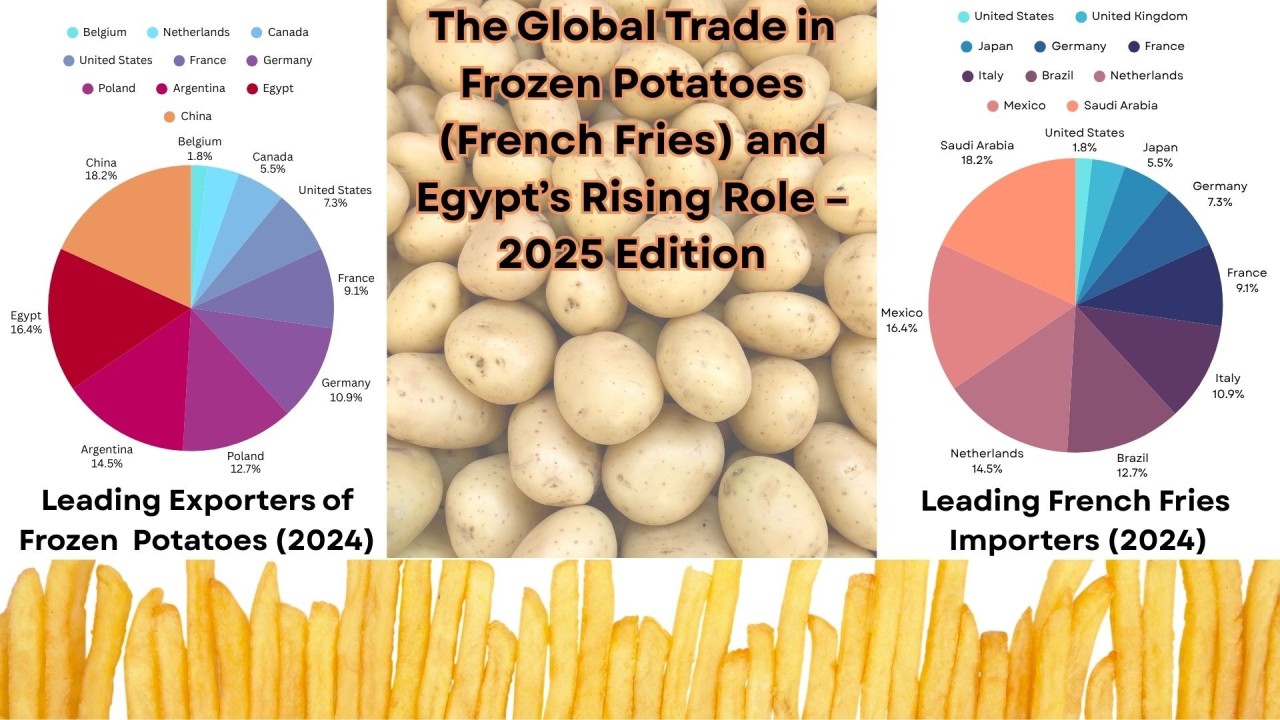
According to World’s Top Exports, global shipments of frozen prepared or preserved potatoes reached US$13.6 billion in 2024. Belgium remains the hub of the European potato processing industry, but competition from Asia and North Africa is increasing. The top exporting countries and their 2024 export values are summarized below.

The EU4 (Belgium, Netherlands, Germany and France) still supply the majority of global frozen fries, but high energy and labour costs have eroded their competitiveness. DCA Market Intelligence warns that the EU’s 2024 potato area increased by 77,000 ha, raising the risk of a 25–30 million‑ton harvest; oversupply and record‑high contract prices could strain processors. Meanwhile, India’s exports increased 35–56 % in 2024, and Chinese exports jumped 75 %.
Leading Importers
Demand is concentrated in wealthy economies with large fast‑food sectors and limited domestic production. Data compiled from Eurovan Trading and IndexBox/Global Trade shows the top import markets by value:
Leading Importer & Exporters

Other notable importers include Spain, Australia, the UAE and South Korea. These figures highlight the importance of trade in meeting global French‑fries demand.
Market Dynamics and Recent Trends
EU oversupply and price pressures
Potato Business reports that the EU potato area expanded by 5.5 % to 1.47 million ha in 2024; the EU4 planted more than 600,000 ha (+7.5 %), risking an oversupply of 25–30 million tones. High production costs and record‑high contract prices (due to energy, labor and storage expenses) raise processor costs. Despite strong global demand (growing >4 % annually), EU exports fell in 2024 as high prices made European fries less competitive, allowing India, China and Egypt to capture market share.
Trade disputes and market access
The World Trade Organization (WTO) ruled in 2025 that Colombia violated trade obligations by imposing anti‑dumping duties on frozen fries from Belgium, Germany and the Netherlands. The duties, imposed in 2018 and extended until 2027, covered 85 % of EU exports; the panel’s decision requires Colombia to remove them. Such rulings shape market access for EU producers.
Emerging markets and investment
- Brazil: McCain Foods announced a €320 million expansion of its Araxá, Brazil, facility to add French‑fry and pre‑formed potato lines. The expansion will reduce Brazil’s reliance on imports and could make Brazil the third‑largest frozen‑fries market. The project includes raw‑potato storage and cold storage and is slated for completion by mid‑2027.
- India: India’s frozen‑potato exports increased by 56.3 % in 2024 to 159 kt, fuelled by new processing plants (e.g., Farm Frites–Kribhco and Agristo–Masa ventures).
- United States: U.S. frozen‑potato imports surged to 388.5 kt in Q4 2024 (+8.2 % YoY), mainly from Canada; U.S. exports still grew (~2 %), with Mexico, Japan and Canada accounting for 77 % of exports.
- Australia: Dispute between Tasmanian growers and processor Simplot over contract price cuts led to fears of profitability; imported frozen chips from China and India quadrupled to 100,000 t, highlighting pressure on domestic processors.
These examples underscore how supply chain investments, trade disputes and currency movements drive shifts in frozen‑potato trade flows.
Egypt’s Rising Role
Egypt has traditionally been a fresh‑potato exporter, but it is rapidly becoming a significant player in the frozen‑fries sector.
Fresh‑potato production and exports
Egypt’s supply advantages:
- Consistent production – abundant volumes and exceptional quality allow Egypt to supply fresh potatoes from January to June, with cold storage extending availability to October.
- New markets – Egypt has successfully penetrated Asian and Far‑East markets; potatoes arrive in good condition despite long transit times and offer competitive prices.
- Surge in Russian demand – after a slump in 2024, Russia’s demand for Egyptian potatoes rebounded, with a 400 % increase expected due to poor harvests in Russia. The UK also increased imports due to frost damage in Cyprus.
These factors enable Egypt to capitalize on supply gaps in Europe and Asia.
Frozen‑potato exports
Egypt’s investment in processing and logistics has translated into explosive growth in frozen‑potato exports:
- According to Egypt’s Food Export Council, frozen potato exports surged 860 % in the first nine months of 2024, reaching US$168 million. This was the most significant growth among food‑industry exports, surpassing soft‑drink concentrates and frozen strawberries.
- Industry sources attribute Egypt’s advantage to year‑round cultivation, high‑starch varieties suitable for fries, efficient cold storage and favorable shipping routes through the Suez Canal. Companies like Farm Frites Egypt, Eurovan Trading and Lamb Weston‑ME operate processing plants and export fries to GCC countries and Europe.
- Global commentary notes that Egypt, India and China are eroding EU producers’ market share by offering competitively priced fries. Egypt is already the world’s ninth‑largest exporter of frozen potatoes, and expansions by Farm Frites and other firms should boost capacity further.
Domestic consumption
While Egyptian per‑capita potato consumption (~31.4 kg) is lower than European averages, local demand for French fries is rising due to urbanization and the growth of fast‑food outlets. Combined with export expansion, this has spurred investment in domestic processing infrastructure.
Conclusion
The global trade in frozen prepared potatoes is characterized by expanding demand and shifting supply dynamics. Europe remains the powerhouse exporter but faces challenges from overproduction, high costs and trade disputes. North America remains both a major supplier and consumer; Asia’s role is growing rapidly as India and China expand processing capacity.
Egypt exemplifies how emerging economies can leverage climatic advantages and strategic location to become significant players. With large fresh‑potato production, extended availability and investments in freezing and processing capacity, Egypt’s frozen‑potato exports jumped 860 % in 2024. This growth, combined with increasing exports to Russia, Asia and the UK, positions Egypt as a pivotal supplier in the coming years.
For stakeholders in the frozen‑fries industry, monitoring developments in production costs, trade policy and investments – particularly in emerging markets – will be essential. Egypt’s rise serves as a reminder that new suppliers can rapidly reshape global trade flows when they invest in quality, storage and logistics.